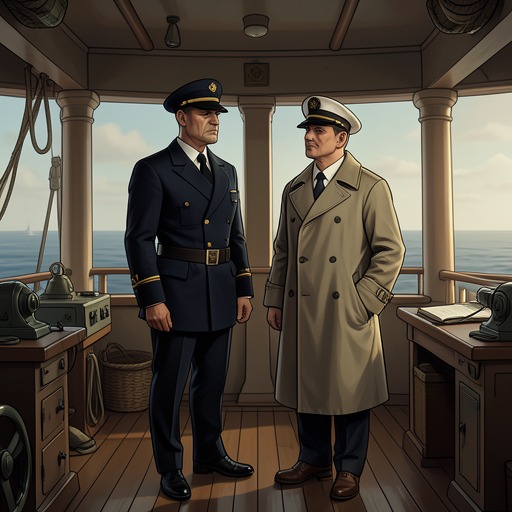
Queeg's Shipboard Rules and Performance Standards
The Caine MutinyQueeg's Shipboard Rules and Performance Standards define the command system Captain Queeg tries to impose on the USS Caine: loyalty in both directions, obedience to written regulations, exemplary performance as the minimum, and close control of the crew’s conduct. Their decisive significance is the widening gap between formal authority and effective shipboard practice. Queeg presents discipline as a unified system under his personal command, but the crew’s selective compliance and Steve Maryk’s practical management reveal how much the ship depends on adaptation beyond the captain’s rules.
The Captain’s Stated Standard
At his first meeting with the officers, Queeg frames command as an exchange: he expects absolute loyalty from those below him and promises loyalty in return. He then insists that shipboard work has a right way, a wrong way, a Navy way, and his way, and that his way is to govern. The phrasing makes his personal authority explicit: regulations matter, but he reserves the right to define how they are applied aboard his ship.
Queeg describes himself as a man of the book. Officers should follow written rules, he says, and any departure requires several strong reasons; he also makes clear that disagreement with him will not prevail. This is not presented as a modest preference for procedure. It joins institutional rules to the captain’s personal judgment, giving him the power to treat deviation both as a breach of regulation and as a challenge to his command.
His performance standard is similarly absolute. Excellent performance is the expected level, ordinary performance falls short, and anything below that is not to be tolerated. At the same time, he initially tells the officers that they should continue their existing duties unless he specifically orders a change. The combination leaves little room for a stable threshold: the officers are to maintain established work while anticipating that Queeg may decide their performance is inadequate and alter expectations.
From Principle to Inspection
The rules become more pointed when Queeg addresses the USS Caine after its orders are changed from a voyage to Pago Pago to target-towing duty at Pearl Harbor. He treats the reassignment as possible evidence either of exceptional service or of doubts about the ship’s competence, while declaring that officers should execute orders rather than speculate about them. He recalls having reported the ship’s engineering performance as below standard, then sets out to make it the Navy’s best target-towing vessel. His insistence on not making a single mistake turns a general aspiration into a demand for near-infallibility.
Queeg also translates performance into visible appearance. He assigns the morale officer responsibility for ensuring that sailors tuck in their shirttails, promising support for strict enforcement and warning that officers, department heads, and the morale officer will all answer for violations. At the end of the meeting, he goes around the table asking individual officers whether they understand and support his statements. Their repeated silence becomes his basis for assuming agreement, although the scene does not show that they share his enthusiasm.
The orders are tested against practical shipboard work. Earlier, during a watch under Captain de Vriess, Willie Keith relays a request from the forward fireroom to blow tubes. Maryk, the officer of the deck, grants permission after checking the flag and explains that the wind carries the smoke clear; when conditions require a course change, the skipper’s permission is needed. The episode presents shipboard procedure as a combination of authority, observation, and operational judgment. Queeg’s subsequent interrogation of the communications staff about the radio guard likewise reveals his scrutiny of established routines: the staff explains that it follows Pearl Harbor procedure by copying the harbor circuit and receives destroyer schedules through the Betelgeuse.
Enforcement and the Circle of Compliance
Queeg’s standards become more concrete after the USS Caine is grounded and damaged another ship while attempting to get underway. At a later officers’ meeting, he expresses displeasure that excellent performance is not standard, announces the target-towing assignment, and insists that his orders must be carried out without speculation. He disclaims responsibility for the ship’s prior state of training, but claims responsibility for everything that happens from then on and says he will not tolerate mistakes. The contrast between this declaration and the recent mishap gives his rules an immediate defensive quality: he demands future perfection while separating himself from the conditions that preceded his command.
A posted order and its enforcement show how quickly his discipline can become collective. After Queeg finds a cigarette butt in a forecastle scupper, he cancels liberty for the entire crew. For the next few days, the deck force keeps the main deck swept; when the USS Caine sails for Kwajalein, the order is shelved and the deck returns to its earlier condition except during sweeping. A sailor is nevertheless assigned to clean the small patch of deck near Queeg’s cabin, the bridge ladder, and the wardroom hatch. Enforcement follows the captain’s presence more reliably than it changes the ship as a whole.
The crew’s resulting practice is described as a Circle of Compliance. Sailors learn Queeg’s habits and paths, observing his rules within the reach of his eyes and ears while much of life beyond that zone continues as before. Unexpected inspections produce new edicts, which are carefully obeyed inside the circle and ignored elsewhere. The account emphasizes that this is not a consciously coordinated conspiracy; it is an informal accommodation that emerges from the crew’s knowledge of where enforcement is likely. Queeg’s rules therefore produce a visible zone of order without establishing consistent discipline throughout the ship.
Effects on the Crew and Ship
The captain’s regime reshapes relations in the wardroom. Queeg becomes increasingly secluded, while Maryk maintains what contact remains between the captain and the ship. Maryk understands that he is responsible for enforcing the rules, yet recognizes that many are impracticable for an overworked, overcrowded crew or would impose costs on the USS Caine’s already narrow margin of seaworthiness. He tolerates the Circle of Compliance and concentrates on keeping the vessel functioning adequately beyond it. His approach is neither simple defiance nor full enforcement; it places operational continuity ahead of an appearance of universal obedience.
The other officers, with Tom Keefer as a leading voice, bond through open dislike and sarcastic mockery of Queeg. Willie Keith, regarded as the captain’s favorite because Queeg treats him more warmly, participates in the ridicule as well. Maryk alone generally refrains, remaining silent, defending the captain at times, or leaving when the jokes continue. The rules thus divide the wardroom even as the captain’s demand for loyalty is meant to unify it. Among the crew, Queeg’s standing ranges from mild dislike to intense hostility, although some sailors consider him an agreeable captain so long as they stay out of his sight. Gunner’s Mate Stilwell is known as a particular target of Queeg’s dislike, and the crew’s differing responses to him reflect their concern that the captain’s hostility could extend to those associated with him.
The costs extend beyond visible inspections. During the USS Caine’s months of repetitive escort duty, Queeg imposes punishments, demands written reports and investigations, and summons officers to meetings in the middle of the night. In one prolonged inquiry, the officers sit for forty-eight hours trying to discover which mess boy burned out a Silex; they never identify him, and Queeg announces a twenty-point reduction in everyone’s fitness rating. Meanwhile, the ship’s work consists of recurring watches and paperwork, and the officers average only four or five interrupted hours of sleep a night. Maryk continues to add entries to his secret log. The system’s paperwork and surveillance do not resolve the underlying operational burdens; they intensify fatigue and make the captain’s conflict with the wardroom part of daily routine.
Limits of the Rules in Crisis
The storm at sea supplies the starkest test of a command system built around obedience and the avoidance of mistakes. As a large wave strikes the bridge and the USS Caine rolls almost onto its side, Maryk calls for the ship to turn into the wind. Queeg, still focused on the telegraph and orders to maneuver, does not immediately yield to the officer’s assessment of the danger. When Stilwell reports an object ahead, Maryk takes command of the controls, orders a sharp turn and full reverse, and brings the ship clear of a wreck.
Maryk then orders the crew to search for survivors and directs the ship to circle the capsized vessel twice. Queeg questions the risk to the USS Caine, while Maryk answers that the crew cannot simply pass by and forget those in danger. This response makes the practical limits of Queeg’s system visible: adherence to the captain’s authority and concern for the ship’s safety do not, by themselves, settle what the situation requires. The action instead depends on immediate observation, delegated expertise, and judgment under pressure. Across the rules’ full arc, the book contrasts Queeg’s demand for standardized perfection with the ship’s reliance on workable procedures, local knowledge, and decisions responsive to changing conditions.